 (925) 293-3313
Thinking of scaling your Amazon empire by opening a second seller account? It’s a powerful strategy for diversifying your brands or product lines, but it’s a path you must walk with extreme caution. Amazon’s rules are strict, and one wrong move can bring your entire operation to a screeching halt.

Amazon’s sophisticated tracking systems are designed to link related accounts. If one of your accounts gets suspended for any reason, the others can fall like dominoes. But for sellers with legitimate business needs, successfully managing multiple accountsis entirely possible. It just requires meticulous planning and a deep understanding of the rules. For those who need expert guidance through this complex process, specialists like EHP Consulting Group can be an invaluable resource. Here is your playbook for managing multiple Amazon seller accounts effectively and protecting your business from costly suspensions.
1. Confirm Your Legitimate Business Need
Before you do anything else, you must have a valid, Amazon-approved reason for a second account. The days of needing to ask for permission are largely gone, but the requirement that a business need be demonstrated is stronger than ever. So, what qualifies?

The most common and accepted reason is owning and operating completely separate brands. If you sell high-end pet supplies under “Pawsitive Living” and budget-friendly hardware under “Toolbox Basics,” these are distinct businesses that warrant separate accounts. Other valid reasons include manufacturing products for two different companies or participating in a special Amazon program that requires a new account. Simply wanting to sell the same products under a new name, or trying to circumvent a prior suspension, is not a legitimate need and will get you shut down quickly.
2. Create a Completely Separate Business Identity
Think of your new Amazon account as an entirely new person. It cannot share a wallet, a phone, or a home address with your original account. Any overlap in core business data is a massive red flag for Amazon’s linking algorithm.

For each seller account, you must have a unique:
- Legal Entity: A separate LLC or corporation.
- Bank Account: A dedicated business bank account used only for that Amazon store.
- Credit Card: A unique credit card on file for payments and fees.
- Physical Address: Do not use the same business or mailing address.
- Phone Number: A dedicated phone line for each account.
Sharing any of these details is the fastest way to get your accounts linked and jeopardize your selling privileges across the board.
3. Build a Unique Digital Footprint
Just as your business entities must be separate, so too must their digital presence. Amazon tracks everything from the IP address you log in from to the cookies stored in your browser. Logging into two different seller accounts from the same computer on the same Wi-Fi network is a critical mistake.
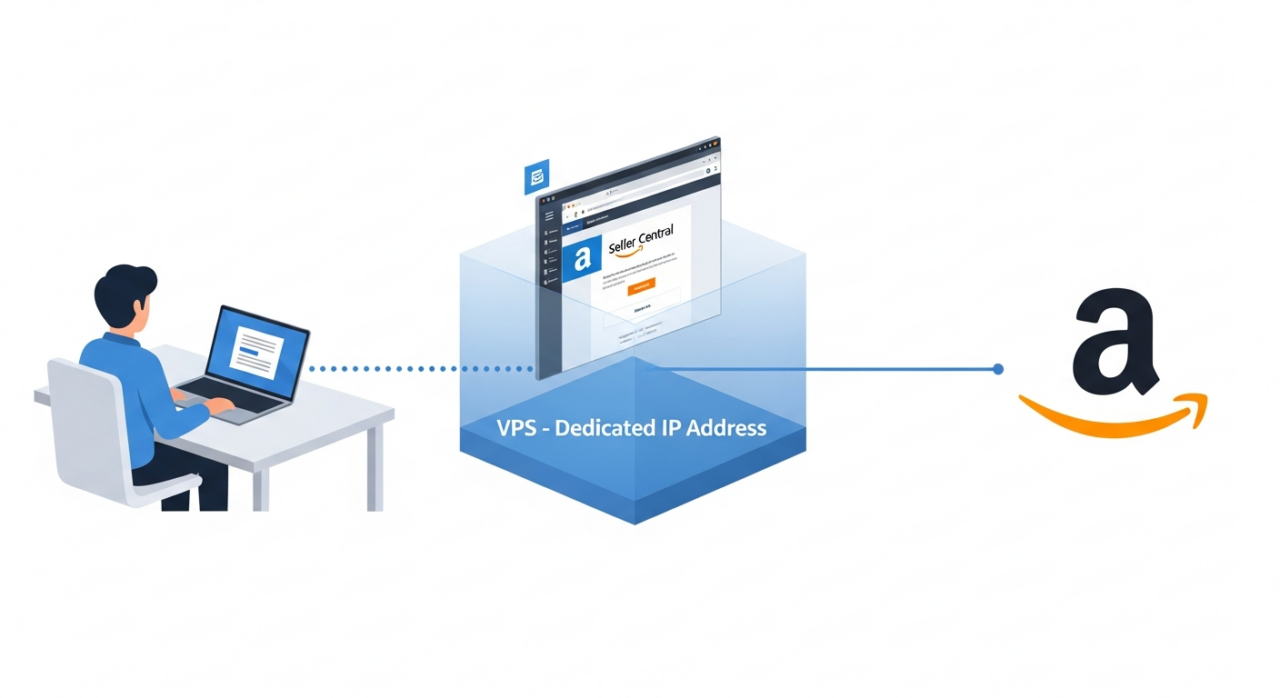
The most robust solution is to use a Virtual Private Server (VPS) for each additional account. A VPS is essentially a remote computer that you access through the internet. It provides a completely isolated environment with its own dedicated IP address, operating system, and browser data. By logging into your second Amazon account only through its dedicated VPS, you ensure its digital footprint never crosses paths with your primary account. Professional services like Amazon Web Services (AWS) or Microsoft Azure offer reliable VPS solutions that create this essential digital separation.
4. Dedicate Your Hardware and Networks
If a VPS isn’t your preferred route, the alternative is to dedicate physical hardware to each account. This means using a completely separate computer or laptop for each Amazon business. This computer should only ever be used for managing that one specific account.

Furthermore, you cannot use the same internet connection. This doesn’t mean just resetting your router. You would need a separate internet service or a dedicated mobile hotspot that is used exclusively for your second account. This strategy is more logistically challenging than using a VPS but follows the same core principle: never allow your accounts to touch the same digital environment.
5. Maintain Impeccable Account Health on All Fronts
Operating multiple accounts is a privilege, not a right. Amazon grants this flexibility with the expectation that you are a seller in good standing. This is the most crucial rule of all: the health of one account impacts all of them.

If your new account gets suspended for a policy violation, a high Order Defect Rate, or any other infraction, Amazon will almost certainly deactivate your original, healthy account as well. You must be twice as diligent. Monitor your performance metrics, address customer service issues promptly, and stay on top of Amazon’s ever-changing policies, often discussed in the seller forums, for every single account you operate. Your entire Amazon business ecosystem is only as strong as its weakest link. If you need help managing this, professional services can help maintain the health of your accounts.
Need Help Growing Your Sales?
We are here to help you scale.