 (925) 293-3313
Navigating the e-commerce landscape can feel like trying to read a map in a storm. With so much competing information, it’s easy for sellers to get lost in exaggerated claims and misleading statistics. To succeed, you need clear, accurate data. We’ve cut through the noise to verify the facts, comparing the titans like Amazon and Walmart to disruptors like TikTok, so you can build your business strategy on a solid foundation.
1. Demystifying the Revenue Race: Amazon vs. Walmart
When you hear revenue numbers thrown around, it’s crucial to check the scale. A recent claim put Amazon’s quarterly revenue at an astronomical “$1887 billion.” This is a significant overstatement. In reality, Amazon’s net sales for its most recently reported quarter were $213.4 billion. While still a massive figure, it’s nearly nine times smaller than the incorrect number.
So, where does that leave Walmart? The assertion that they are “catching up” is nuanced. Walmart’s most recent quarterly revenue was an impressive $190.7 billion. While this puts them in the same league as Amazon, it’s important to note that Amazon’s revenue for the same period was still higher. Both are retail giants operating at an incredible scale, but having the correct figures helps you accurately gauge their current market standing.

2. Analyzing TikTok’s Explosive Growth
While the legacy marketplaces battle it out, the claims surrounding TikTok’s rise are largely on the money. The platform’s estimated revenue for 2024 hit approximately $23 billion, backed by a staggering 42.8% year-over-year growth. This isn’t just a social media platform anymore; it’s a commercial powerhouse.

This explosive growth is fueled by a massive and engaged user base, currently estimated at 1.9 billion monthly active users worldwide. For sellers, this confirms that TikTok is not a passing trend but a vital and rapidly expanding channel for social commerce that demands serious consideration in any modern e-commerce strategy.
3. Re-evaluating eBay’s Buyer Trends
The narrative that eBay’s buyer base is in a state of terminal decline is misleading. While the platform’s active buyer count has fallen from its peak in early 2022, the story doesn’t end there. The most recent data from the end of 2025 actually shows a 1% year-over-year *increase*, bringing the total to 135 million active buyers.

This suggests a stabilization, not a freefall. For sellers who may have written off the platform, this data is a critical reminder that eBay retains a substantial and dedicated customer base. The trend is more complex than a simple story of decline, and the platform remains a viable marketplace for many businesses.
4. Counting Sellers: Getting the Real Numbers for Amazon and Walmart
Understanding your competition is fundamental, and that starts with knowing how many other sellers are on a platform. The estimate that Walmart has between 150,000 and 250,000 sellers is accurate; the current figure sits around 200,000.
The picture for Amazon, however, is often misconstrued. The claim of “9 million” sellers is technically true but highly misleading. That number represents the total number of *registered* seller accounts globally. The more important metric for competition analysis is the number of *active* sellers, which is closer to 1.9 million. This is a critical distinction. It means the competitive landscape, while still vast, is significantly less crowded than the “9 million” figure implies, though navigating it still benefits from powerful tools like Helium 10.

5. Decoding Referral Fees: A Look at Amazon vs. Walmart
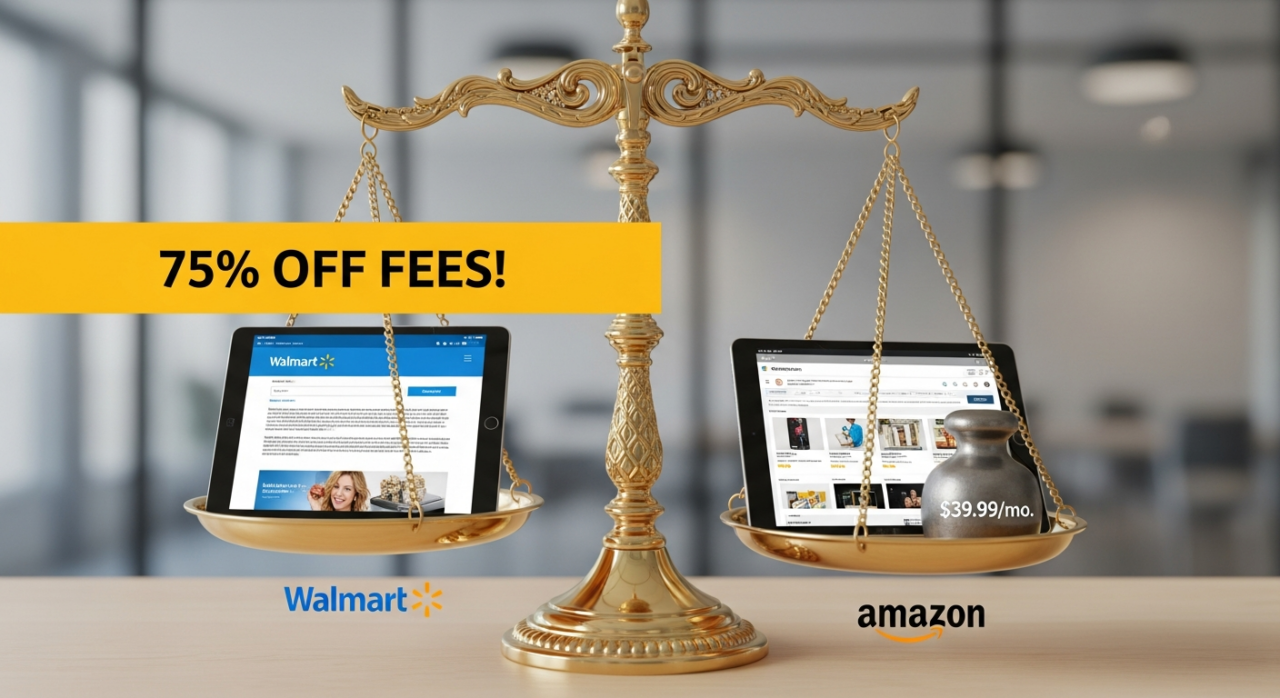
The cost of selling is a top concern, and referral fees are a huge part of that equation. It’s generally true that Amazon’s fees are among the highest. Both platforms charge referral fees that typically range from 8% to 15%, depending on the category. However, Amazon also has a $39.99 monthly fee for its professional seller plan, a cost that Walmart does not have.
The claim that Walmart reduces fees to zero once a product sells well needs clarification. This isn’t a standard, automatic policy. Walmart’s standard referral fees are comparable to Amazon’s. What Walmart *is* doing is aggressively courting new sellers with powerful incentives, a strategy our services can help you navigate. These include limited-time promotions, such as offering 0% referral fees on items in specific categories or providing new sellers with discounts of up to 75% on their fees. These are strategic promotions to gain market share, not a permanent feature for all top-selling products.
Ready to Grow on Amazon?
At EHP Consulting Group, we help sellers rank higher, sell more, and scale faster.
👉 Contact us to audit your Amazon strategy
👉 Learn more about our full Amazon account management services
YouTube Channel Link: EHP Consulting Group on YouTube
TikTok Profile Link: EHP Consulting Group on TikTok
Written By: Jane Camille Olegario
Email: [email protected]
Website: http://www.ehpconsultinggroup.com
Number: 925-293-3313
Date Written: March 16, 2026