
 (925) 293-3313
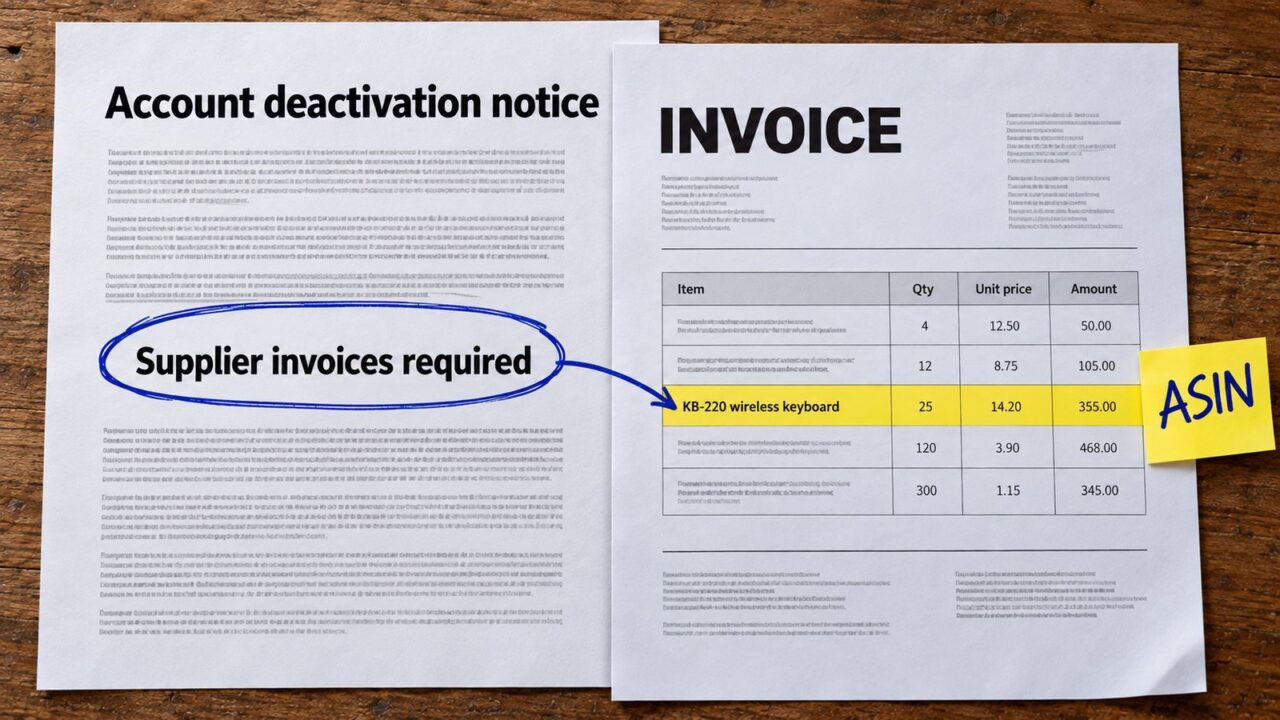
Every issue in an Amazon deactivation notice needs an answer, backed by the evidence Amazon asks for. If the notice says supplier invoices are required, the answer is the invoice line that covers the cited ASIN. If it asks what you changed, an invoice cannot answer, because it only proves you bought something. That is how an Amazon account appeal works: Amazon’s guidance asks you to explain every issue, give its root cause, and document the specific actions you took.
Your plan of action, the written explanation Amazon reviews, is built from those answers, so gather the documents before you write. If your fix was a new supplier check, for example, the proof is the dated record of each check.
Start with the notice
Open the deactivation notice (many sellers call it a suspension) and mark every issue Amazon lists. At the bottom you will find the ASINs under review. ASINs are Amazon’s product IDs, and each one needs evidence.
Sign in to Seller Central, the site where you run your Amazon selling account. Open Account Health, the dashboard that lists your account’s policy violations. Reactivate your account sits at the top of that page.
Open it now only to see what Amazon will ask for, and submit nothing yet. It may be a questionnaire or supporting documents, and sometimes an acknowledgement or a quiz. Then read the policy Amazon cited, as our suspended-accounts guide advises.
Sort every issue: confirmed or contradicted
Sort the issues into two piles. Some your records confirm, such as a supplier you never checked or stock counts that drifted. Others your records contradict, such as a product detail Amazon has wrong. Confirmed issues get a plan of action; contradicted ones get a short correction with proof.
Then match the evidence to the cause:
- Process failure: attach a dated record of the process you changed. Amazon’s guidance gives an unverified supplier, inventory errors and weak quality control as examples of a root cause, the underlying reason the problem happened.
- Wrong product detail: attach photographs and a signed manufacturer declaration, as in the Cart Wheel Deals example below.
- Suspected intellectual property violation (a claim that you used someone else’s brand, trademark or patent): attach authorization letters, invoices and product certifications, as in the Edmark example below.
In the Edmark case, a whole-account deactivation, the earlier appeals went in with no supporting attachments and were denied. The revised plan of action carried those documents plus a written process for checking each supplier.
Our case study reports that Amazon reinstated the account after reviewing the complete documentation. That is one reported case, and your appeal will be judged on its own documents.
If the notice asks for invoices
Only some notices ask for invoices. If yours does not, skip to writing the plan of action. If it does, check the invoices before you write a word of the plan.
Amazon’s rules count back 365 days from your notification. Its invoice page says to submit them through the banner at the top of Account Health.
The check we would do first is the link between each invoice line and the cited ASIN. Here is a made-up example. The supplier’s line reads “KB-220 wireless keyboard, 25 units”, but your listing sells that keyboard as model K220W.
The supplier’s code KB-220 does not, by itself, establish which Amazon ASIN the invoice covers. If the line also prints the model number or barcode, highlight it, which Amazon allows. If it shows only the supplier’s own code, say in your plan which ASIN the line covers and attach a supplier document that lists both its code and your model number.
Each invoice must show
- The supplier’s name, phone number, address and website.
- An issue date inside the 365 days.
- Quantities that cover the sales and stock of each cited ASIN over that period.
- Products by name, model number or barcode (a UPC, EAN or ISBN number), the exact version, color or style of a variation (one size or color of a listed product), and every item in a bundle.
- A completed, fulfilled and unaltered transaction, as a PDF, JPG, PNG or GIF of up to 10 MB. Pricing may be hidden if everything else stays visible.
Amazon rejects
- Quotes and pro forma invoices (drafts issued before a sale is complete).
- Self-issued invoices, or ones where the supplier looks like the same business as the buyer.
- Digitally manipulated or editable files, such as Excel or Word documents.
- Illegible or incomplete copies.
- Invoices sent by email or file sharing instead of through Seller Central.
Add sales records for the cited ASINs. An invoice does not have to be in English, and Amazon may contact the supplier to verify it.
Check dates and quantities together (made up). Say the notice arrived on October 1, 2026. The ASIN sold 380 units and has 90 in stock, 470 in all.
- An invoice dated October 14, 2025 for 300 units is inside the period but covers only 300 of the 470. You need a second qualifying invoice for the rest.
- An invoice dated August 20, 2025 falls outside the period and cannot count.
If you have nothing else, say so and explain the gap. Never change a date to make an invoice fit.
Write the plan of action for the problem the notice names
Our suspended-accounts guide builds most plans of action from three parts: the root cause, the corrective action you have already taken, and the preventive step that stops it happening again. Write it in the first person and own the mistake, with “I” or “my business failed to” and no blame on anyone else.
Keep it short and factual. Amazon’s questionnaire guidance asks you to leave out emotional language, other questions and references to open support cases.
Compare a weak sentence, “We take this very seriously and have improved our processes,” with a stronger one: “I did not check the supplier’s business documents before my first order. On March 3, 2026, I verified the supplier and saved the record, which is attached.”
The sample below has the whole shape: an opening line that names the notice, one block per problem, and a numbered list of attachments, each tied to the problem it proves. It lists the problems in the notice’s order; in your own plan, put the best-documented one first.
It is made up, so use it for structure only. Every fact in yours has to come from your own records. SKU means your own stock code for a product.
A sample plan of action for two problems
This plan of action responds to the deactivation notice of March 1, 2026, which lists two issues: supplier documentation and inventory accuracy.
Problem 1: supplier documentation. Root cause: my business did not require a recorded check of a supplier’s business details before the first order. Corrective action: on March 3, 2026, I verified the supplier’s business documents, physical address and website, and saved the check. Prevention: since March 10, my purchasing staff must complete a verification record before any first order with a new supplier.
Problem 2: inventory accuracy. Root cause: I updated stock by hand once a month, and the figures drifted from the warehouse count by 46 units across 12 SKUs. Corrective action: on March 10, 2026, I reconciled every SKU against the warehouse count. Prevention: reconciliation is now weekly, starting March 17, 2026.
Attachments:
- Supplier invoice, January 20, 2026, with the KB-220 line highlighted (Problem 1, the purchase under review).
- Supplier product sheet listing its code KB-220 beside model K220W (Problem 1, connects the invoice line to the model shown on the cited ASIN’s listing).
- Supplier verification record, March 3, 2026 (Problem 1, corrective action).
- Purchasing procedure, effective March 10, 2026 (Problem 1, prevention).
- Inventory reconciliation log, March 10, 2026 (Problem 2, corrective action).
- Weekly reconciliation schedule and the first weekly log, March 17, 2026 (Problem 2, prevention).
When the flagged product detail is wrong
A disputed detail gets a shorter response that asks for one correction:
The notice describes this product as containing lithium batteries. It ships with two AAA alkaline batteries. I attach photographs of the battery compartment and a signed manufacturer declaration dated March 2, 2026, and ask for the battery attribute to be corrected.
The Cart Wheel Deals case was this kind of appeal, for one product listing rather than a whole account. An ASIN was flagged for coin or button cell batteries although the product used an AC adapter or optional D-size batteries.
We sent product photos and a signed manufacturer declaration and asked only for that product detail, the battery type, to be corrected. According to the published case, the flag was removed and the ASIN reinstated. The same short format fits an account notice that cites a wrong product detail.
Submit the appeal, then be ready for a second round
Before you submit, read the draft against the notice once more. Every issue needs an answer, and so does each ASIN on the list. Put your best-documented issue first, so the reviewer meets your strongest evidence before anything else.
Select Submit in the appeal flow and watch your email. Amazon says to expect a reply within two days. Keep the notice and everything you sent in one folder, because any follow-up will be answered from it.
In our experience even a strong first appeal is very difficult to get accepted, so expect a follow-up. A confusing appeal brings more requests, and each round gets harder than the last.
When one comes back, check what was missing. Amazon sometimes wants an affidavit (a signed, sworn statement) or a specific invoice it had not asked for before.
Open Account Health, select View Appeal and answer exactly what the new message asks for. If it asks for the invoice behind one ASIN, send that invoice with the matching line highlighted, and answer nothing it did not ask.
If you have gone back and forth a few times with an appeal you know is solid, our guide’s next step is to ask Account Health Support, Amazon’s seller support team for account problems, to escalate it, which means passing it to a more senior team.
Before each round, run one test on your draft. Beside every attachment, write the one sentence of the plan it proves. An attachment with no sentence comes out, and an action you claim with no attachment needs one, because Amazon’s guidance asks for documentation of each action.
Frequently asked questions
What if a supplier will not give me an invoice?
Tell Amazon what you asked the supplier for and attach the records you do have. Amazon rejects self-issued and altered invoices, so never create one to fill the gap.
How long does reinstatement take?
Amazon says to expect a reply to an appeal within two days. A reply is not always a decision, and an appeal can take more than one round. In the Edmark case, the client put the whole wait at about a month.
Sources
Amazon Seller Central help pages, checked October 18 and 19, 2026 (sign-in required): Appeal an account deactivation or listing removal, Complete an appeal questionnaire to reinstate selling privileges and Invoice requirements for appealing a policy violation. The EHP case studies and EHP’s suspended-accounts guide are linked where discussed.
If you want a second reader before you submit, send us the notice and your draft. We run that attachment test on your draft and check every issue against the notice. Contact EHP Consulting Group.